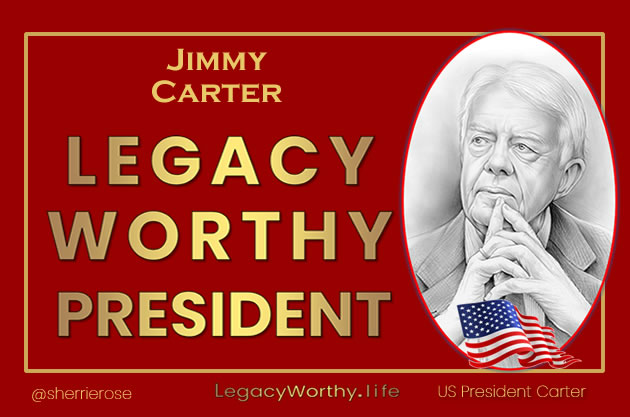
James Earl Carter, Jr. – 39th President of the United States
On January 20, 1981, Jimmy Carter walked out of the White House at age 56. Most former Presidents fade into comfortable retirement. Carter picked up a hammer.
What came next would last 43 years—nearly eleven times longer than his presidency. And it would define his legacy far more than anything he accomplished in the Oval Office.
This is the story of a man who proved that power isn’t about the office you hold. It’s about what you do after everyone thinks you’re done.
From Peanut Farmer to President
James Earl Carter, Jr. was born on October 1, 1924, in Plains, Georgia—a town so small you could walk it end-to-end in fifteen minutes. He grew up on a peanut farm with his parents and three siblings, working the land, attending the local public school, and joining the Boy Scouts at 13.
There was nothing in his childhood that suggested he’d one day lead the free world.
But Carter was determined. He attended Georgia Southwestern College, then earned admission to the United States Naval Academy, graduating in 1946 as a submariner officer. He served during World War II and the Korean War, rising to the rank of Lieutenant. In 1949, he earned a Master of Science degree in nuclear engineering from Union College.
In 1953, he left the Navy to take over the family peanut business. That same year, he began what would become a lifelong partnership: marriage to Rosalynn Smith, his childhood sweetheart. They would remain together for 77 years.
Carter entered politics in 1962, winning a narrow race for the Georgia State Senate. In 1970, he became Governor of Georgia—the first Democrat to hold that office since Reconstruction. As governor, he desegregated public schools, expanded educational opportunities, and implemented environmental protections.
In 1976, running as an outsider from the South, he defeated incumbent President Gerald Ford. Jimmy Carter became the 39th President of the United States.
The One-Term President
Carter’s presidency was marked by both triumph and struggle. His greatest achievement came in 1978 when he personally brokered the Camp David Accords—a peace agreement between Egypt and Israel that ended decades of hostility. For 13 days, he met with Egyptian President Anwar Sadat and Israeli Prime Minister Menachem Begin, refusing to let them leave until they reached an agreement.
They signed. And the peace has held for nearly 50 years.
Carter also established diplomatic relations with China, created the Department of Energy, signed legislation protecting millions of acres of Alaskan wilderness, and championed human rights on the global stage.
But his presidency faced enormous challenges: rising inflation, high interest rates, an energy crisis, and the Iran hostage crisis. In 1980, Ronald Reagan defeated him in a landslide.
At 56, Jimmy Carter was done being President.
And that’s when his greatest work began.
In 1982, Carter founded The Carter Center with Rosalynn. Over the next four decades, it would become one of the world’s most respected humanitarian organizations, advancing peace, health, and human rights in over 80 countries.
The Power of What Comes After
Most former Presidents write memoirs, give speeches, and build libraries. Carter did all that—he wrote over 30 books—but he also did something unprecedented: he put on work boots and got his hands dirty.
Through Habitat for Humanity, Carter personally built hundreds of homes for low-income families. Not as a photo op. As actual construction work. Well into his nineties, you could find him on a job site, hammer in hand, working alongside volunteers.
Through The Carter Center, he monitored elections in countries struggling with democracy, mediated conflicts between warring nations, and worked to eradicate diseases like Guinea worm disease. When Carter started, there were 3.5 million cases per year. Today, there are fewer than a dozen.
He traveled to over 145 countries. He negotiated peace agreements between Ethiopia and Eritrea, Sudan and Uganda, Haiti and the Dominican Republic. He spoke out for human rights—particularly for women and children in developing countries.
He never stopped working.
The Nobel Prize
In 2002, the Norwegian Nobel Committee awarded Jimmy Carter the Nobel Peace Prize. Not for his presidency. For his post-presidency.
The citation read: “For his decades of untiring effort to find peaceful solutions to international conflicts, to advance democracy and human rights, and to promote economic and social development.”
Carter was 78 years old. He would live another 22 years.
100th Birthday: The Only President to Reach a Century
On October 1, 2024, Jimmy Carter turned 100 years old. He became the first and only U.S. President to reach a century of life.
The Carter Center threw a star-studded concert celebration in Atlanta on September 17. The event featured performances celebrating the “Rock & Roll President”—a man who loved music as much as he loved service.
By his 100th birthday, Carter had:
- Helped monitor 113 elections in 39 countries
- Nearly eradicated Guinea worm disease (from 3.5 million cases to fewer than 20)
- Provided clean water access to more than 3 million people annually
- Built hundreds of homes with Habitat for Humanity
- Negotiated numerous peace agreements
- Received the Nobel Peace Prize, Presidential Medal of Freedom, and Congressional Gold Medal
- Written over 30 books
His audiobook “Last Sundays In Plains: A Centennial Celebration” won a Grammy Award at the 67th Grammy Awards for Best Audiobook, Narration, and Storytelling Recording.
The U.S. Postal Service honored him with a Forever stamp, celebrating his humanitarian legacy in peace and human rights.
Rosalynn: A Partnership of 77 Years
Jimmy Carter married Rosalynn Smith on July 7, 1946—the same year he graduated from the Naval Academy. They were partners in every sense: in marriage, in politics, in humanitarian work, in life.
Rosalynn was not just a First Lady. She was a mental health advocate, a champion for women’s rights, and co-founder of The Carter Center. Jimmy often called her his “equal partner” and credited her with much of his success.
Together they had four children: John William (Jack), James Earl III (Chip), Donnel Jeffrey (Jeff), and Amy Lynn.
On November 19, 2023, Rosalynn Carter died at age 96 after battling dementia. Jimmy was by her side. They had been married for 77 years—the longest presidential marriage in American history.
Carter would live another 13 months, spending his final days in Plains, Georgia—the same small town where his journey began.
A Legacy That Outlives Power
Jimmy Carter died on December 29, 2024, at his home in Plains, Georgia. He was 100 years and 88 days old.
On January 9, 2025, a state funeral was held at Washington National Cathedral. President Biden declared it a national day of mourning. Flags flew at half-staff for 30 days.
The tributes poured in from around the world. Not for the President he had been. For the humanitarian he became.
“One person, standing on principle, can make a positive difference in the lives of many.” —Jimmy Carter
Carter proved that legacy isn’t about how long you hold power. It’s about what you do with your time on earth. He showed us that a one-term presidency can be the beginning of a historic life—not the end of one.
He demonstrated that real influence comes not from commanding armies or signing legislation, but from showing up. Building homes. Eradicating disease. Monitoring elections. Speaking for those who have no voice.
Jimmy Carter lived to 100. But more importantly, he lived well for 100 years.
Learn More About President Jimmy Carter
Explore his legacy and humanitarian work:
