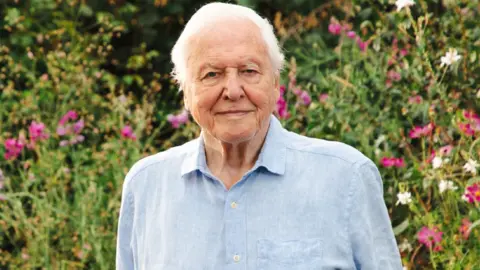
Sir David Attenborough – The voice for nature turns 100
On Friday, May 8, 2026, Sir David Attenborough celebrates his 100th birthday.
For more than 70 years, his voice has been synonymous with the natural world. Hundreds of millions have watched his documentaries. He has shown us mountain gorillas in Rwanda, orcas hunting seals in Antarctica, the last tortoise of his species dying in the Galápagos. He has made us marvel at the teamwork of nature and weep at its fragility.
He is still working. Still advocating. Still at the vanguard of efforts to protect the environment. And at 100, he has produced some of his most impactful work in his final decades.
“Your ability to communicate the beauty and vulnerability of our natural environment remains unequalled.”
— Queen Elizabeth II
A Childhood of Fossils and Seahorses
Born on May 8, 1926, David Attenborough spent his childhood doing what many naturalists do: collecting. Fossils. Insects. Dried seahorses. The remnants of life that most children overlook.
His BBC career began in 1954 when he presented “Zoo Quest,” a program that involved traveling to remote parts of the world and bringing animals back to London Zoo. It was adventure television. It was discovery. It was unlike anything else on British screens.
By the 1970s, he had risen to programme controller at the BBC. He was an executive. A decision-maker. Someone who could have spent the rest of his career in offices making calls about budgets and schedules.
Instead, he walked away. He wanted to return to making nature documentaries.
Think about that. At the peak of institutional power, he chose fieldwork over a corner office. He chose gorillas over boardrooms.
Life on Earth
In 1979, at age 52, David Attenborough released “Life on Earth.”
He wrote the entire 13-hour script. He traveled the world for three years. He told the story of evolution from the simplest organisms to humans. It was ambitious. It was comprehensive. It made him a household name.
One scene, in particular, became iconic: Attenborough sitting quietly in the Rwandan jungle as two young mountain gorillas climbed onto him, playing with his hair, exploring this strange human who had entered their world.
He didn’t narrate during the moment. He just let it happen. The silence spoke more than any script could.
That restraint—that willingness to let nature speak for itself—became a hallmark of his work.
Dozens of Documentaries. Hundreds of Millions Watching.
After “Life on Earth,” the documentaries kept coming. “Blue Planet.” “Frozen Planet.” “Planet Earth.” “Dynasties.”
Each one pushed the boundaries of what nature filmmaking could be. New camera technology allowed unprecedented views of animal behavior. Crews spent years in the field capturing single sequences. The result was television that felt like witnessing miracles.
Orcas working together to create waves that knocked seals off ice floes. Birds of paradise performing elaborate courtship dances. Lions defending their territory against rivals. The drama of survival, adaptation, and evolution playing out in real time.
Attenborough’s voice guided viewers through it all. Warm. Curious. Never condescending. Always in awe.
“That’s typical David,” said Mike Salisbury, a producer who worked on several of his documentaries. “He makes everything really enjoyable.”
Lonesome George
In 2012, at age 86, Attenborough told the story of Lonesome George, the last surviving Pinta Island tortoise.
George was alone. The last of his kind. Conservationists had tried for decades to find him a mate, to save his species, but none of the attempts succeeded.
Attenborough, filming George in the Galápagos, spoke with a mix of sadness and kinship:
“He’s about 80 years old, and getting a bit creaky in his joints—as indeed am I.”
Two weeks after filming, George died. His species became extinct.
The moment moved millions to tears. Not just because a species was lost, but because Attenborough helped us understand what that loss meant. He made extinction personal.
Blue Planet 2 and the Plastic Crisis
As Attenborough moved through his 80s and into his 90s, his sense of urgency grew. Climate change was accelerating. Species were disappearing. The threats to the natural world were no longer theoretical—they were immediate.
In 2017, at age 91, he released “Blue Planet 2.”
The series highlighted the scourge of plastic in the ocean. Albatrosses unwittingly feeding plastic to their chicks. Sea creatures tangled in debris. Entire ecosystems poisoned by human waste.
The public response was unprecedented. “Blue Planet 2” achieved some of the highest viewing figures in British television history. The images of wildlife suffering because of plastic pollution jolted public opinion.
Within months, the British government and major retailers announced measures to reduce plastic use. Plastic bag charges increased. Single-use plastics were banned. Corporations scrambled to appear environmentally responsible.
One documentary. One 91-year-old man. Policy change across a nation.
“I think every single person who’s seen anything that Sir David has done has been inspired to care about nature.”
— Doug Gurr, Director of the Natural History Museum in London
Still Working at 100
At 100, Sir David Attenborough is still active. Still producing work. Still advocating for the environment.
His admirers include Britain’s royal family, Barack Obama, and pop star Billie Eilish. He has topped national popularity polls as Britain’s most admired man and greatest living cultural icon.
But friends say he rolls his eyes at the accolades. He doesn’t do this for fame. He does it because the planet needs voices. Because species are disappearing. Because someone needs to show people what they’re losing.
In Britain, his centenary is being marked with a week of special broadcasts on the BBC, a live concert at the Royal Albert Hall, museum events, nature walks, and tree planting.
It’s fitting. A man who spent seven decades showing us the natural world is being honored with celebrations that return people to nature.
The Voice That Never Stops
David Attenborough’s instantly recognizable voice is synonymous with the story of nature. For 70 years, that voice has narrated the drama, beauty, and tragedy of the natural world.
He has shown us what we stand to lose. And he has shown us what’s worth protecting.
At 100, he’s not finished. Because the work isn’t finished. The threats to the environment haven’t diminished. The need for voices advocating for nature hasn’t decreased.
So he keeps working. Keeps filming. Keeps speaking.
Because that’s what you do when you’ve spent a century watching the planet. You don’t retire from caring about it.
Explore Sir David Attenborough’s Work
Learn more about the voice for nature:
